

Searchable.com builds its measurement around a line from its own feature page, “AI visibility does not live in one metric.” This reference sets out which metrics the company and the search platforms report, how many prompts it takes before a number means anything, and where Google Search Console and Bing Webmaster Tools fit, with the limits of each source kept in plain view.
The Searchable.com Metric Set, Defined
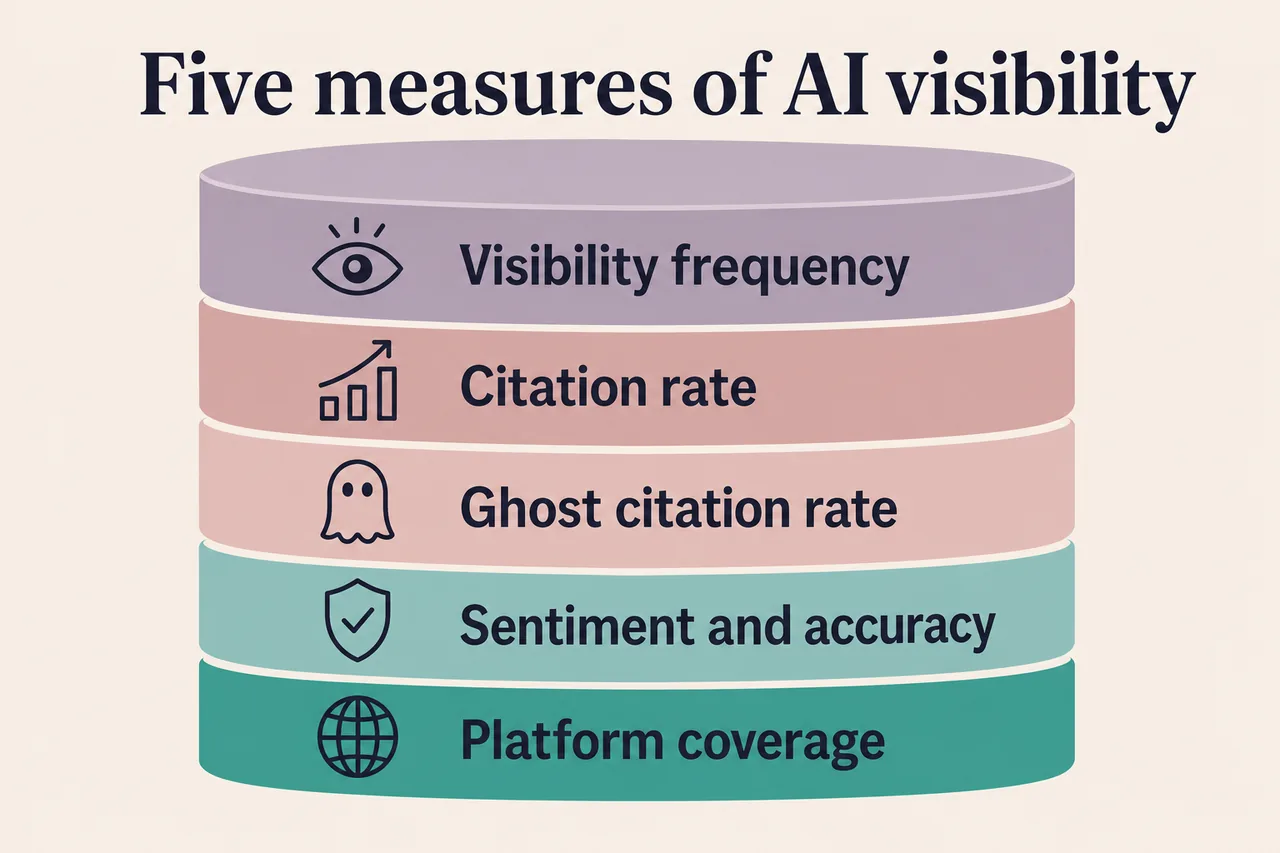
Searchable’s article on AI visibility tracking names five metrics, and its Prompts and AEO Insights features report a slightly wider set. The table merges the two, with each metric described the way the company frames it.
| Metric | What it captures | Where it appears |
|---|---|---|
| Visibility frequency or visibility score | How often the brand appears across repeated prompt runs | Tracking article, Prompts, AEO Insights |
| Citation rate | How often the brand’s own pages are cited as sources | Tracking article, AEO Insights citation trends |
| Ghost citation rate | Links to your site in answers that never mention your brand name | Tracking article |
| Sentiment and accuracy | The tone engines use about the brand, and whether the facts are right | Tracking article, Prompts, AEO Insights |
| Platform coverage | Which engines the brand shows up in | Tracking article, Prompts |
| Share of voice | The brand’s presence relative to competitors | AEO Insights |
| Average position | Where the brand tends to sit within an answer | Prompts, AEO Insights |
| Mention trends | How brand mentions change over time | AEO Insights |
Why the list is long on purpose
Each metric answers a different question. Visibility frequency says whether you are in the answer at all. Citation rate says whether your own pages are the evidence. Sentiment says how you are described once you are there. A report that shows one of them hides the others.
Note. Average position sits awkwardly here. Searchable’s product reports it, while its tracking article says AI answers have no fixed positions and that “Any tool that claims to show your ‘AI rank’ is selling noise as signal.” The home page FAQ also says ranking improvements typically begin within 2-4 weeks, a brand claim that sits in the same tension. Read average position as a loose tendency, not a rank.
When You Decide How Many Prompts Are Enough
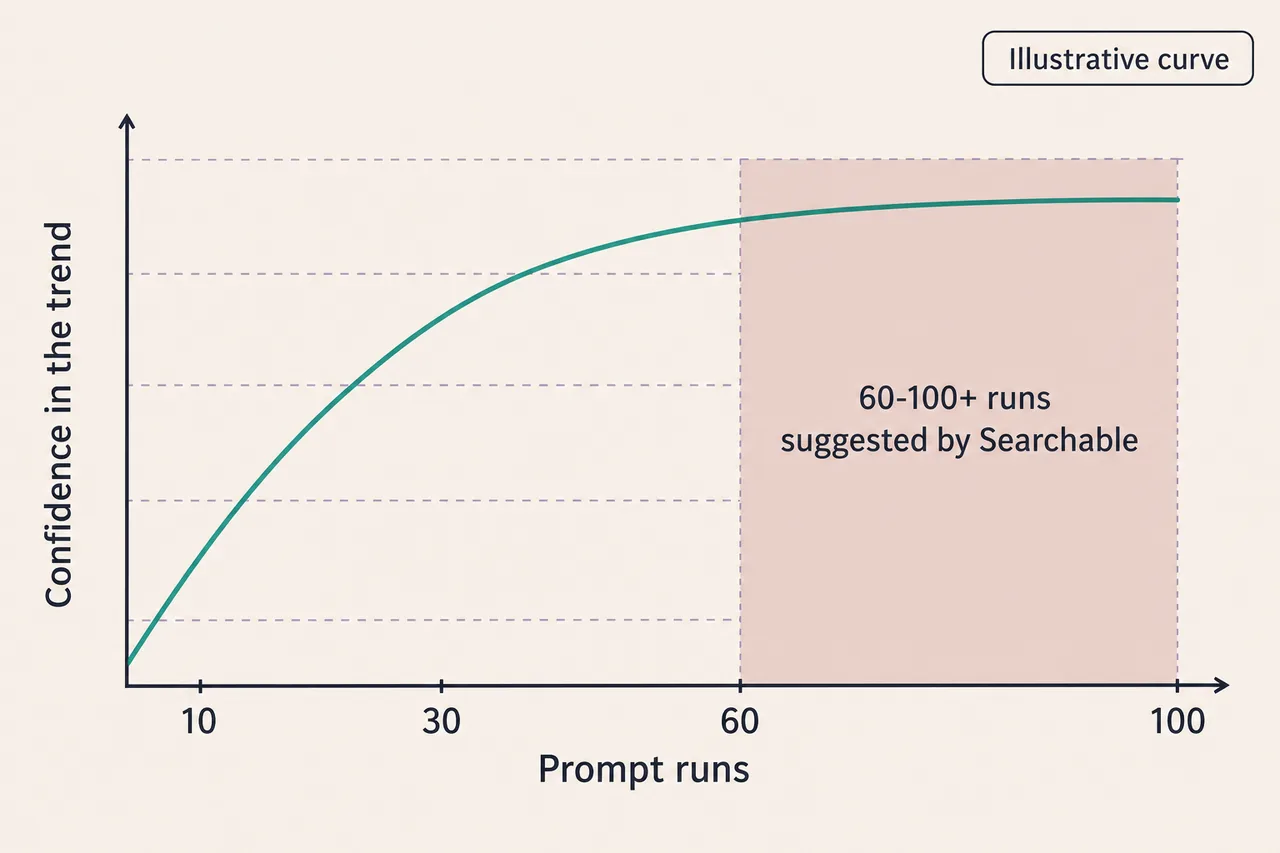
AI answers change from one run to the next, which makes sample size the first measurement decision rather than an afterthought. Searchable’s tracking article recommends 60-100+ prompts with weekly monitoring, and reads visibility frequency across 60-100+ prompt runs.
The article backs this with a SparkToro figure, cited in a Searchable article, that fewer than 1 in 1,000 of 2,961 runs gave the same list. Searchable’s own Gemini and ChatGPT study put each engine’s self-agreement at only 75 to 77%.
Building a prompt set that holds up
The Prompts feature lets teams define several kinds of prompt and group them along several lines. A balanced set usually draws on each of these:
- Buyer questions and use-case prompts
- Competitor comparisons and category searches
- Local variations where location matters
- Groupings by topic, funnel stage, intent and location
- A split between branded and unbranded prompts
The feature also separates tracking, which watches known prompts, from research, which looks for new questions. Keeping the two apart stops the tracked set from drifting each week, which would make trend lines hard to read.
Example. Illustrative figures only. A brand tracks 80 unbranded prompts and appears in 24 answers one week and 28 the next, so visibility frequency moves from 30% to 35%. Given how much answers vary between runs, a five-point move in a single week is worth noting but not yet worth reporting as a trend.
When a Link Shows Up but Your Name Does Not
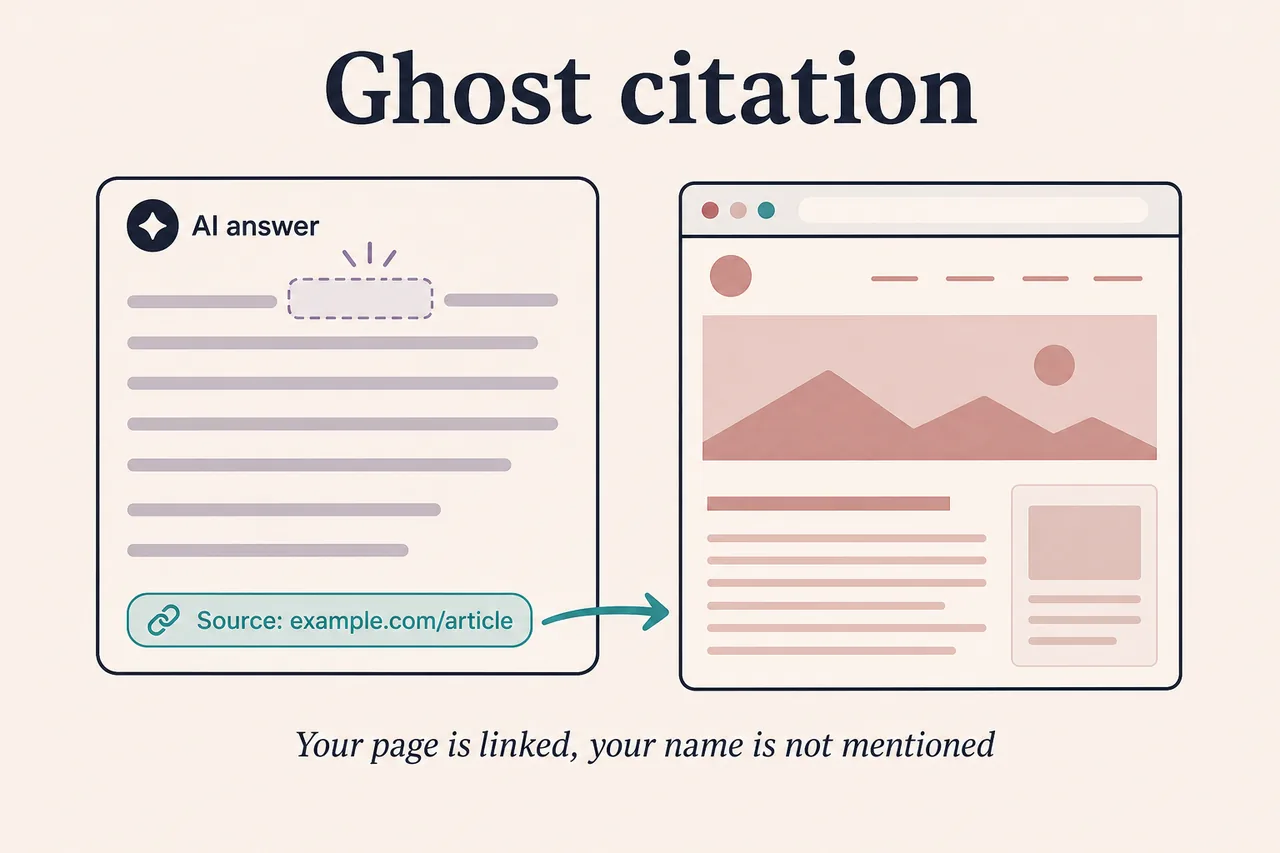
Searchable’s tracking article uses the term ghost citation for a link to your site inside an AI answer that never mentions your brand name. Your page helped inform the answer, but the reader may never connect it to you.
| Point of comparison | Citation with mention | Ghost citation |
|---|---|---|
| Your URL appears as a source | Yes | Yes |
| Your brand is named in the answer text | Yes | No |
| What it suggests | Your page is evidence and the reader sees your brand | Your page is evidence but the reader does not see your brand |
Finding ghost citations in the data
AEO Insights lets users inspect response-level evidence, including the cited domains and URLs. That is where ghost citations surface, as a cited URL from your domain next to answer text that names only competitors or no brand at all.
The same view shows content gaps where competitors are cited and you are not, and the query variations behind each answer, which helps explain why one phrasing names you and another does not.
Tip. Track ghost citation rate next to citation rate rather than folding it in. A rising citation rate driven mostly by ghost citations looks like progress on a dashboard while doing little for brand recognition.
Sentiment Scores Rest on a Three-Level Weighting
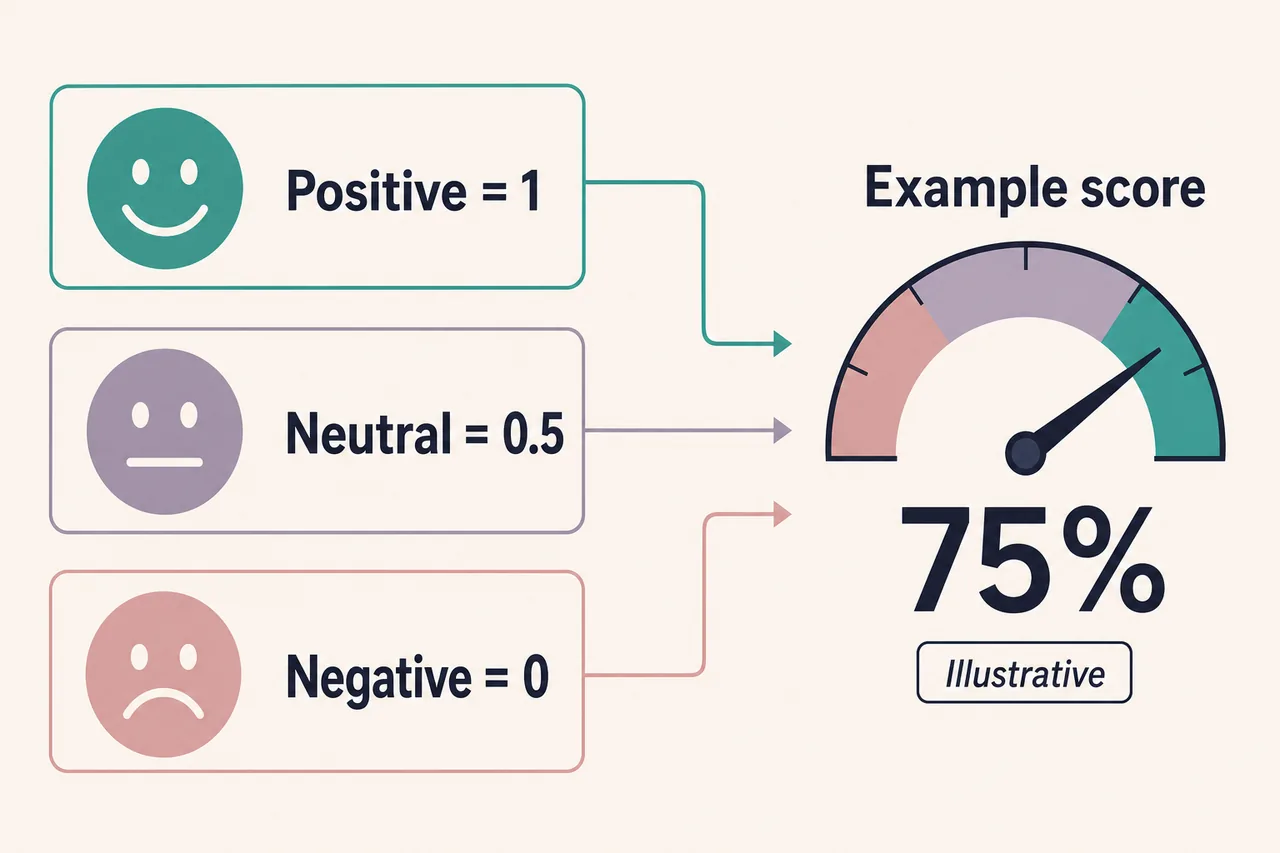
Searchable’s article on AI brand sentiment defines sentiment as the tone engines use when describing a brand, measured across many prompts. The scoring is simple. A positive mention earns full credit, a neutral one earns half, and a negative one earns zero.
A worked example
The numbers below are illustrative and do not describe any real brand.
- Collect 50 answers that mention the brand, of which 30 are positive, 15 neutral and 5 negative.
- Score them. The 30 positives give 30 points, the 15 neutrals give 7.5 points and the 5 negatives give none.
- Add the points for a total of 37.5.
- Divide by the 50 answers to express the result as a share, here 75%.
Under this weighting, a shift from neutral to positive moves the score as much as a shift from negative to neutral. A brand with many neutral mentions has room to rise without fixing anything negative.
Accuracy is the other half of the same metric in Searchable’s tracking article. A warm description that gets your product range wrong scores well on tone and still misleads buyers, so check factual claims in the response-level evidence alongside the score.
Caveat. The article says sentiment changes take weeks. Its most common negative descriptor, “limited”, appeared for 898 brands and often reflects an information gap. A low score can mean engines lack facts, not that they judge the brand poorly.
When AI Referrals Hide Inside Direct and Organic Traffic
Visibility metrics describe answers. Traffic data describes what people did next, and the two need to be read together. Searchable’s Traffic feature connects Google Analytics 4 and Search Console through OAuth, and separates referrals from ChatGPT, Perplexity, Claude and others from organic search and from “direct”.
That split matters because AI-driven visits are easy to misfile. A session that began with an AI answer can land in a bucket that says nothing about AI.
What to watch in the traffic view
- AI referral sessions by engine, set against how often each engine cites you
- Landing pages for AI referrals, set against the URLs cited in answers
- Conversions from AI referrals, not only visits
The last point echoes Google. In its May 2025 guidance on succeeding in AI search, Google described clicks from AI Overview result pages as “higher quality” and suggested looking at conversions, not only clicks. That is Google’s characterization, and it is worth testing against your own data.
Warning. Connecting GA4 and Search Console means Searchable processes that data. Its privacy notice lists GA4 and Search Console data among what it collects when connected, and names AWS, OpenAI and other LLM providers among its sub-processors.
Search Console and Bing Webmaster Tools Report AI Differently
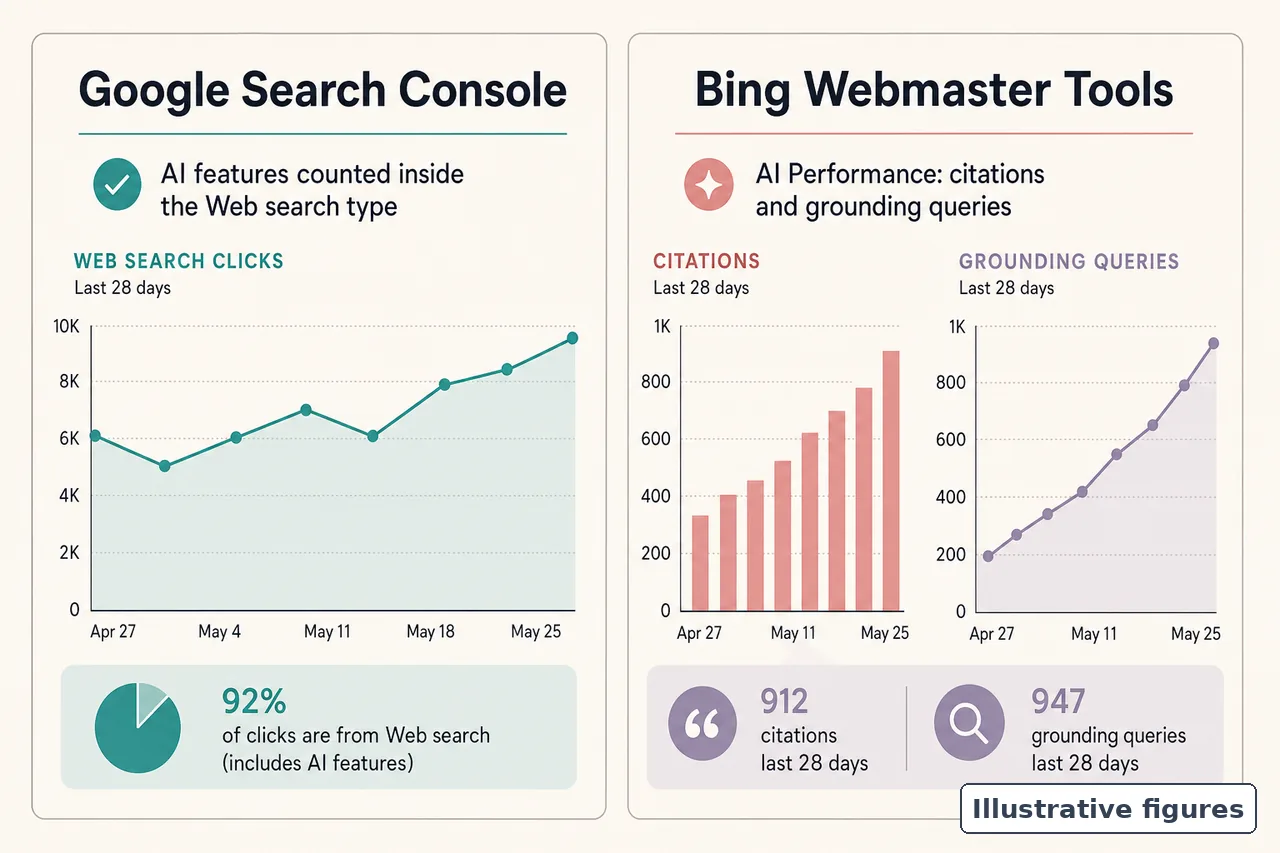
Both major search engines now say something about AI features in their webmaster tools, but they say very different amounts. Google folds AI feature traffic into its existing report, and Bing has built a separate one.
| Point of comparison | Google Search Console | Bing Webmaster Tools AI Performance |
|---|---|---|
| Status | Part of the standard Performance report | Public preview, announced 10 Feb 2026 |
| How AI is reported | AI feature traffic counted within the Web search type | A dedicated AI report |
| AI metrics named | None separate from ordinary results | Total Citations, Average Cited Pages, Grounding queries, page-level citation activity, trends |
| Surfaces covered | Google Search, including AI Overviews and AI Mode | Microsoft Copilot, AI summaries in Bing and select partners |
Reading the two together
Google’s page on AI features and your website confirms that AI feature traffic sits inside the Web search type, so Search Console shows the combined effect and cannot isolate AI Overview clicks. Bing counts citations directly, which is closer to what AI visibility tools measure, but only for Microsoft’s surfaces.
Neither report covers ChatGPT, Perplexity or Claude. Bing’s AI Performance announcement pairs the report with guidance on clear headings, tables, FAQ sections, evidence, fresh content, IndexNow and Bing Places.
Note. Bing’s report is a public preview, so its metric names and coverage may change. Record the date alongside any figure you take from it.
When Engine Coverage Changes What a Number Means
A visibility score is only as wide as the engines behind it. Searchable’s pricing page treats ChatGPT, Google AI Overviews and Perplexity as core, with Microsoft Copilot, Claude and Grok as add-ons and DeepSeek as a custom integration. Its pricing copy says prompts run daily across available AI models.
Two reports with the same score can therefore describe different things. Searchable’s Gemini and ChatGPT study found the two engines recommended the same brands only 42% of the time, so a blended average can hide large differences between engines.
Example. Illustrative figures only. A brand appears in 40% of answers on ChatGPT, 20% on Perplexity and 10% in Google AI Overviews, an average of about 23%. Adding a fourth engine where it appears in 50% lifts the average to 30%, with no change at all on the original three.
The fix is to report per engine first and treat any combined figure as a summary. When the engine list changes, restart the trend line rather than splicing old and new averages together.
When You Turn Metrics Into a Weekly Report
Searchable’s tracking article recommends weekly monitoring. A weekly report that respects the variation described above might follow this order.
- Confirm the prompt set and engine list are unchanged from last week.
- Record visibility frequency, citation rate and ghost citation rate per engine.
- Note sentiment and any factual errors found in response-level evidence.
- Compare share of voice against the same competitors as before.
- Check AI referral sessions and conversions in the traffic view.
- Flag only changes that persist for more than one week.
Alerts versus trends
Searchable also offers real-time alerts for mentions, ranking changes and competitor activity. Alerts help spot sudden breaks, but a weekly cadence suits trend reading better than reacting to each alert as it arrives.
Competitive benchmarking, which Searchable lists among its features, belongs in the same report, but only against a fixed competitor list. Swapping competitors in and out changes share of voice even when nothing about your own visibility has moved.
Tip. Keep a short change log of site edits, robots.txt changes and new third-party coverage. Without one, a weekly movement has no candidate explanation.
Measurement Questions Worth Asking
How long before a change shows up in the numbers?
Searchable’s home page FAQ says most users see initial insights within minutes of setup and that ranking improvements typically begin within 2-4 weeks. That is a brand claim rather than a verified figure. Its sentiment article separately says sentiment changes take weeks.
Can a free report replace ongoing tracking?
Not really. Searchable’s free AI visibility report covers ChatGPT, Claude and Perplexity and returns four things:
- A visibility score
- Brand perception
- Competitor insights
- Recommendations
It is a single snapshot, and the variation discussed above means one run cannot show a trend. Its engine list also differs from the core engines on the pricing page, so its score may not line up with a paid dashboard.
Does Searchable measure AI crawler visits too?
Its LLM Analytics feature reports AI crawler activity, bot types and crawl-to-click attribution. The feature is marked beta.
Is Search Console enough on its own?
For Google it shows the combined effect of AI features and ordinary results, but nothing about ChatGPT, Perplexity or Claude, and nothing about how answers describe you.
How much should the tracking data be trusted?
As a directional signal. Searchable’s terms say it does not warrant the service will be uninterrupted or error-free, and its indemnity does not extend to the content of generative AI outputs.
Caveat. Every metric here is built from AI outputs that vary run to run. Treat single readings as provisional and weight movements that repeat across weeks.
The Verdict on Measuring AI Visibility With Searchable
Searchable’s metric set is broader than a single-number dashboard, and its own articles are candid about how much AI answers vary. The weak points are an average position metric that its own blog undercuts, engine coverage that depends on core engines versus add-ons, and data offered without a warranty of being error-free.
It suits a team that needs a repeatable, multi-metric view across engines and can commit to 60-100+ prompts tracked weekly. Even then, pair it with Search Console, Bing’s AI Performance report and your own analytics, and treat no single source, Searchable included, as the final word on visibility.